Last Wills & Testaments in The Lehigh Valley
Secure Your Legacy in Northampton County, Lehigh County, and the Lehigh Valley
At Madsen Law Offices, located in the heart of Easton, Pennsylvania, we understand the importance of planning for the future. Preparing a Last Will and Testament is a crucial step in securing your legacy and documenting your instructions for administration under applicable law. Our experienced attorneys handle estate planning and are committed to providing compassionate and comprehensive legal services to the residents of Easton, Bethlehem, Allentown, Nazareth, and surrounding areas in the Lehigh Valley.
We focus estate planning on wills, powers of attorney, and healthcare directives; if your situation raises trust questions, raise them at a consultation and we'll point you the right way.
Why You Need a Last Will and Testament
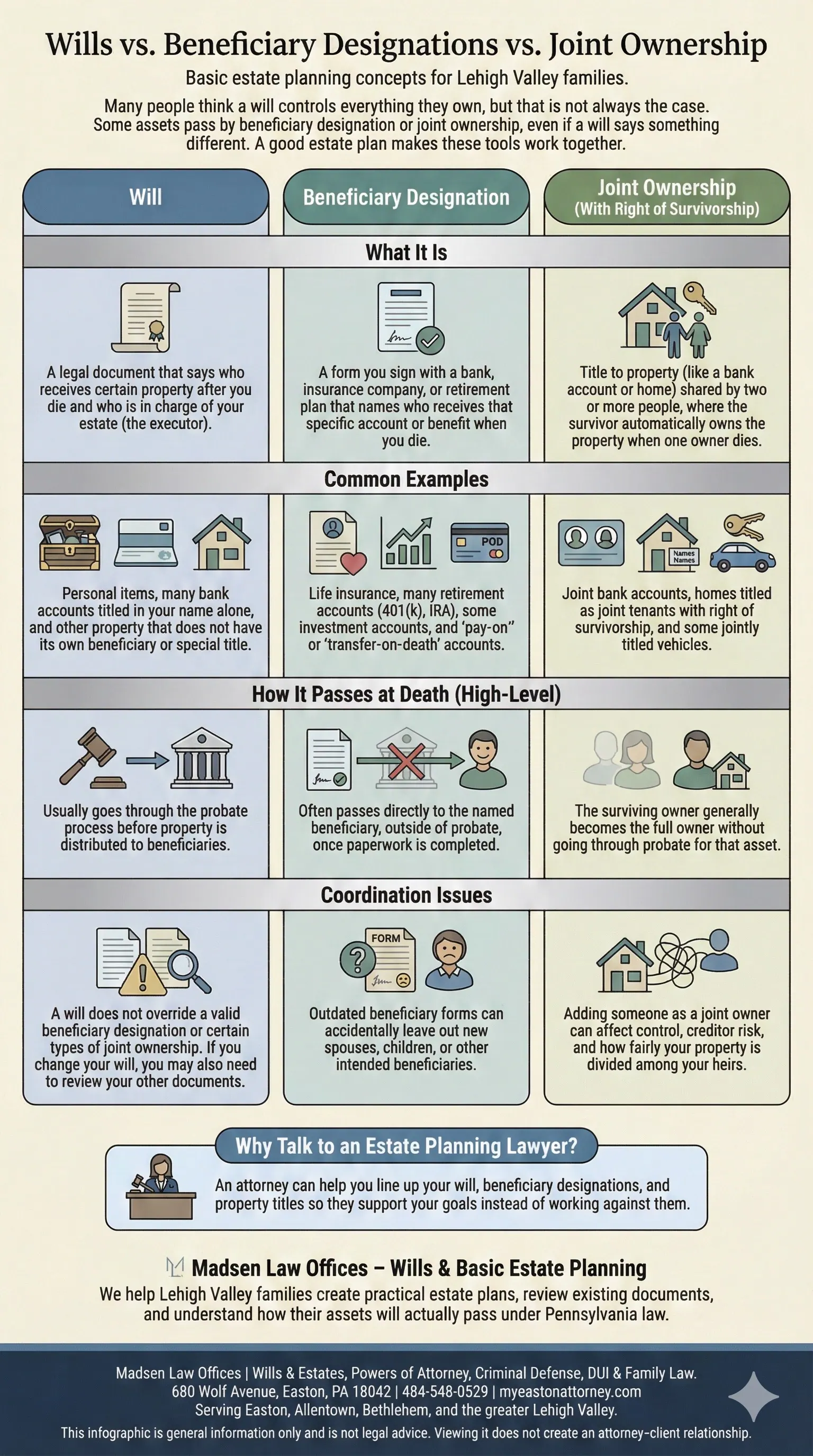
A Last Will and Testament directs how probate property is administered and distributed at death. Property controlled by a beneficiary designation, survivorship title, or another nonprobate arrangement may pass outside the will. Without a valid will, probate property passes under Pennsylvania intestacy law, which may not match your plan. A will can:
- Name beneficiaries to receive probate property.
- Nominate an executor to seek letters and administer the estate.
- Address testamentary guardianship for minor children, subject to Pennsylvania’s statutory requirements.
- Coordinate the estate plan with beneficiary designations, property ownership, and separate health-care documents.
Our Last Will and Testament Services
Madsen Law Offices offers a range of services tailored to meet the unique needs of our clients in Northampton County, Lehigh County, and beyond:
- Custom Will Drafting: Our attorneys will work closely with you to craft a will that reflects your wishes and meets all legal requirements.
- Amendments and Updates: Life changes such as marriage, divorce, births, and asset changes may necessitate updates to your will. We are here to help you make any necessary revisions.
- Core Estate Planning: We prepare wills, powers of attorney, and health-care directives and coordinate them with beneficiary and title decisions.
- Probate and Estate Administration: After a loved one has passed, we provide support to executors and beneficiaries to navigate the probate process with ease.
Experienced Estate Planning Attorneys Serving Easton and Beyond
Our team at Madsen Law Offices brings a wealth of knowledge and personalized attention to each client’s case. We pride ourselves on our ability to offer empathetic, detailed, and strategic legal advice to help you prepare your Last Will and Testament.
Contact Us Today
Don’t wait to secure your legacy and protect your loved ones. Contact Madsen Law Offices today to schedule a consultation with one of our seasoned estate planning attorneys. Serving clients in Easton, Bethlehem, Allentown, Nazareth, and the entire Lehigh Valley area, we are here to assist you every step of the way.

Signing a Pennsylvania will: validity and probate proof
Pennsylvania law. The execution rule is simpler than most people expect: Every will shall be in writing and shall be signed by the testator at the end thereof.
20 Pa.C.S. § 2502.
Two witnesses are required for the special execution methods. If the testator signs by mark, the mark must be made in the presence of two witnesses who sign the will in the testator’s presence. If another person signs at the testator’s direction, the testator must declare the instrument to be the will in the presence of two witnesses, who sign it in the testator’s presence.
Validity and probate proof are different questions. At probate, every will must be proved. For a will signed by the testator, subscribing witnesses are preferred when readily available, and proof of the testator’s signature is preferred. A properly attested will with the statutory self-proving acknowledgment and witness affidavits ordinarily lets the Register accept those affidavits as proof without locating witnesses later—unless the will is contested or was signed by mark or by another person under § 2502. 20 Pa.C.S. § 3132; § 3132.1.
We prepare ordinary, testator-signed wills with two witnesses and the statutory self-proving acknowledgment and affidavits as a matter of course. But if you are evaluating a signed will that lacks subscribing witnesses, do not assume it is invalid. Bring it in.
Top 10 Things to Consider when Creating Your Last Will & Testament
Inventory Your Assets: List all your assets, including real estate, investments, bank accounts, valuable personal property, and digital assets. This comprehensive inventory will guide you in deciding how to distribute your assets.
Decide on Beneficiaries: Clearly identify who will inherit your assets. Beneficiaries can include family members, friends, charities, or institutions. Be specific to avoid any ambiguity.
Nominate an Executor: Name the person you want to serve as personal representative. The nominee does not receive authority merely from being named in the will; the Register must grant letters. 20 Pa.C.S. § 3155.
Testamentary Guardian for Minor Children: A will can address testamentary guardianship, but 20 Pa.C.S. § 2519 imposes specific eligibility and family-status requirements. Discuss how the statute applies to your circumstances rather than assuming any parent can make an effective appointment.
Specific Gifts: If you have specific items that you want to leave to certain individuals, such as family heirlooms, jewelry, or personal items, list these out separately to ensure they go to the intended recipients.
Consider Debts and Taxes: Be aware of any debts and taxes that may impact your estate and its distribution. Proper planning can help minimize the tax burden on your beneficiaries.
Funeral Arrangements: Although not binding, you can include your preferences for funeral arrangements to guide your family. This can cover the type of ceremony, burial or cremation, and any other specific wishes.
Legal Requirements: Pennsylvania generally requires a written will signed by the testator at the end. Two-witness execution rules apply when the testator signs by mark or another person signs at the testator’s direction. Ordinary wills are commonly witnessed and self-proved to simplify probate.
Review and Update Regularly: Life changes such as marriages, divorces, births, and deaths can affect your initial decisions. Review and update your will regularly to reflect any significant life changes.
Seek Professional Advice: Consult with an estate planning attorney to ensure that your will is legally sound and all your bases are covered. A professional can provide guidance tailored to your specific circumstances and help avoid common pitfalls.
Top 10 Questions About Wills in Pennsylvania
What is a will and why do I need one? A will directs the disposition of probate property at death and may nominate a personal representative and address testamentary guardianship when the statute applies. It does not control every asset or make health-care decisions during life.
Who can make a will in Pennsylvania? Any person 18 years of age or older who is of sound mind can make a will in Pennsylvania.
What are the requirements for a will to be valid in Pennsylvania? Ordinarily, the will must be in writing and signed by the testator at the end. The two-witness execution rules apply when the testator signs by mark or another person signs at the testator’s direction. Witnesses and a statutory self-proving acknowledgment and affidavits are still standard practice because they simplify proof at probate.
Can I write my own will, or do I need an attorney? Pennsylvania law does not require an attorney to draft a will. Counsel can help apply the execution rules, coordinate probate and nonprobate transfers, and reduce ambiguity; no drafting method can guarantee that a dispute will never occur.
What happens if I die without a will in Pennsylvania? If no valid will disposes of probate property, Pennsylvania’s intestacy rules determine the statutory shares based on the surviving family members. Nonprobate transfers still pass under their governing title, designation, or agreement. 20 Pa.C.S. § 2101.
How can I change my will? A codicil can amend a will, but it must satisfy the execution rules applicable to wills and can create ambiguity when read with the original. A replacement will is often cleaner; the right method depends on the existing document and the change.
Does a will cover all of my assets? No. A will governs property in the probate estate. Property controlled by survivorship title, a beneficiary designation, a payable-on-death or transfer-on-death arrangement, or a funded trust may pass outside the will if the governing arrangement is effective.
What is an executor, and how do I choose one? An executor is the person nominated in a will to serve as personal representative. The Register grants letters testamentary; the nominee does not have estate authority merely because the will names that person. Choose someone trustworthy, organized, and available to handle records, debts, taxes, deadlines, and beneficiary communications. 20 Pa.C.S. § 3155.
What are the tax implications of inheriting property? Pennsylvania inheritance tax can apply to taxable transfers by will, intestacy, or operation of law, including certain nonprobate transfers. Whether tax is due and the rate depend on the transfer, available deductions or exemptions, and the beneficiary’s relationship to the decedent. Review the Pennsylvania Department of Revenue guidance for the current framework.
What should I do if my circumstances change? If your circumstances change, such as through marriage, divorce, the birth of a child, or the death of a beneficiary, it's important to update your will. This ensures that your estate plan reflects your current wishes and circumstances.