
Child Abuse Defense Attorneys & CYS, CYF & DHS Expungement Lawyers in Northampton & Lehigh County
Children & Youth Services attorneys located in Easton, Serving the Greater Lehigh Valley
Our attorneys are experienced in dealing with all types of cases of alleged child abuse and neglect. The firm handled a custody matter involving Northampton County Children & Youth for custody on behalf of Grandparents. We have also handled numerous indicated status appeals and reunited many parents with their children.
If you are reading this, you likely already know how difficult it can be to deal with a Children and Youth Services Agency. It may feel like the deck is stacked against you, and due to the way most cases are handled, if may very well be.
Contact us early to help. The initial investigation and first few hearings in any dependency case will have a long lasting impact on the development of the case and your custody rights.
2024 Juvenile Dependency Adjudication Outcomes
Latest complete county caseload reports available as of July 31, 2026.
Sources: AOPC Lehigh County 2024 report and AOPC Northampton County 2024 report.
Juvenile Dependency Court Proceedings in Easton, Allentown & Bethlehem
1. Agency Investigation or Referral
The source, scope, and urgency of an agency contact vary.
A county Children & Youth agency may become involved after a ChildLine report, a referral from another professional or agency, a court matter, or information received in another way. Ask for the caseworker’s identity, the purpose of the contact, any written notice, and the next deadline. Preserve messages and documents, make a factual chronology, and seek advice before assuming that every investigation follows the same path.
Safety plans: voluntary on paper, consequential in practice
Pennsylvania practice. Early in some investigations, a county agency proposes a written safety plan addressing where a parent may stay, whether contact must be supervised, or other short-term conditions. An agency-proposed safety plan is not itself a court order and ordinarily depends on caregiver agreement. Pennsylvania law says an agency has no legal authority to compel a family to accept voluntary protective services, but it may explain that it can seek court involvement if the family declines. Services may be voluntary or supplied under an interim or final court order. 23 Pa.C.S. § 6370; § 6371.
The decision still has litigation consequences. If no agreement is reached and the agency believes court action is necessary, it may seek protective-custody or dependency relief. If a plan is signed, the agency may later offer alleged noncompliance as evidence bearing on safety, risk, or cooperation; that does not make noncompliance contempt of court unless a judicial order independently applies. Ask for the plan in writing and clarify who is restricted, what contact is allowed, how supervision works, how long the plan lasts, when it will be reviewed, and how it ends. The practical answer is neither “always sign” nor “never sign”: obtain advice before agreeing, refusing, or changing the arrangement, and obey every existing court order.
Removal follows separate rules. A county-agency worker may not take custody without judicial authorization. In a defined emergency, a police or juvenile-probation officer may take protective custody without a prior order, and limited medical protective custody also exists. An application for judicial authorization must follow within 24 hours, and protective custody cannot continue beyond 72 hours without a shelter-care hearing. 23 Pa.C.S. § 6315; § 6375(i)–(j); Pa.R.J.C.P. 1202; Rule 1242(d).
The ChildLine database: indicated reports and the 90-day clock
Pennsylvania law. A child-abuse report ultimately is categorized as unfounded, indicated, or founded, although status may remain pending while a related proceeding is unresolved. “Unfounded” means neither founded nor indicated; it does not necessarily mean the allegation was affirmatively proved false. Under 23 Pa.C.S. § 6303, an indicated report is an agency determination that substantial evidence supports the alleged abuse; it is not a judicial adjudication. A founded report rests on one of § 6303’s qualifying outcomes, which can include guilty pleas or findings, dependency or delinquency adjudications, ARD dispositions, juvenile consent decrees, or final PFA orders meeting the statutory conditions.
When the required identifying information is known, an indicated or founded report is maintained in Pennsylvania’s confidential Statewide database. The final-status notice must describe entry in the database and the potential effect on future employment. The report appears on child-abuse-history certifications required for many paid and volunteer positions involving direct contact with children; it is not a universal employment bar, and the effect depends on the position and governing law. 23 Pa.C.S. § 6339; § 6344; § 6344.2; § 6368(f).
The remedy is deadline-driven. A person named as a perpetrator in an indicated report may, within 90 days of being notified of the status of the report
request administrative review or appeal directly and request a hearing. 23 Pa.C.S. § 6341(a)(2). If administrative review is chosen, DHS must send the Secretary’s decision within 60 days; that 60-day rule does not describe the decision time for a direct hearing. If review is denied, a merits hearing must be requested within 90 days after notice of that decision. If DHS does not act within the prescribed time, the statute also supplies a hearing right.
At a merits hearing before the Bureau of Hearings and Appeals, the department or county agency must prove by substantial evidence that the report should remain indicated. The statute separately supplies hearing-scheduling, evidence-disclosure, decision, reconsideration, and Commonwealth Court appeal deadlines. A later good-cause request may sometimes be available, but it is not a substitute for a timely appeal. Preserve the status notice and envelope, and follow the notice’s filing instructions exactly: the first 90 days run from notification even if the recipient did not understand the notice.
2. Shelter Care or Other Emergency Hearing
Emergency proceedings can move quickly.
A shelter-care or other emergency hearing may occur when the agency seeks continued out-of-home placement or other immediate relief. The governing petition, removal circumstances, notice, counsel status, and current court order determine the issues and deadlines. Gather the papers promptly and obtain case-specific advice rather than relying on a general timeline.
3. Adjudication Hearing
The court decides whether dependency was proved.
At an adjudication hearing, the court hears evidence on the petition and decides whether the child is dependent. Under 42 Pa.C.S. § 6341(c), a dependency finding requires clear and convincing evidence. Parties may present evidence and challenge the opposing proof under the governing statutes and rules. A waiver, stipulation, or consent can have important consequences and should not be accepted or rejected on the basis of a blanket website rule.
4. Disposition and Permanency Hearings
Later hearings address placement, services, safety, and permanency.
If the court adjudicates a child dependent, disposition and later permanency proceedings may address placement, services, compliance, progress, safety, visitation, and the permanency goal. Section 6341(d) permits the court to consider specified reports and other probative information at disposition while preserving opportunities to examine, controvert, and cross-examine as provided there. Before removing a dependent child from the home at disposition, § 6351(b) requires recorded findings. The actual order and evidence—not a generalized hearsay label—control.
5. Termination of Parental Rights
Last Chance Hearings
If a child has been in placement for at least 15 of the most recent 22 months, the juvenile court must determine at a permanency hearing whether the county agency has filed or sought to join a petition to terminate parental rights and taken steps toward an adoptive placement. That filing expectation does not apply when the child is being cared for by a suitable relative, the agency documents a compelling reason why filing would not serve the child’s needs and welfare, or the family has not received the services necessary to pursue a safe return within the permanency-plan time frames. The threshold does not itself terminate parental rights. Termination requires a separate proceeding and proof of a statutory ground under 23 Pa.C.S. § 2511, together with consideration of the child’s needs and welfare.
CYS Infographic
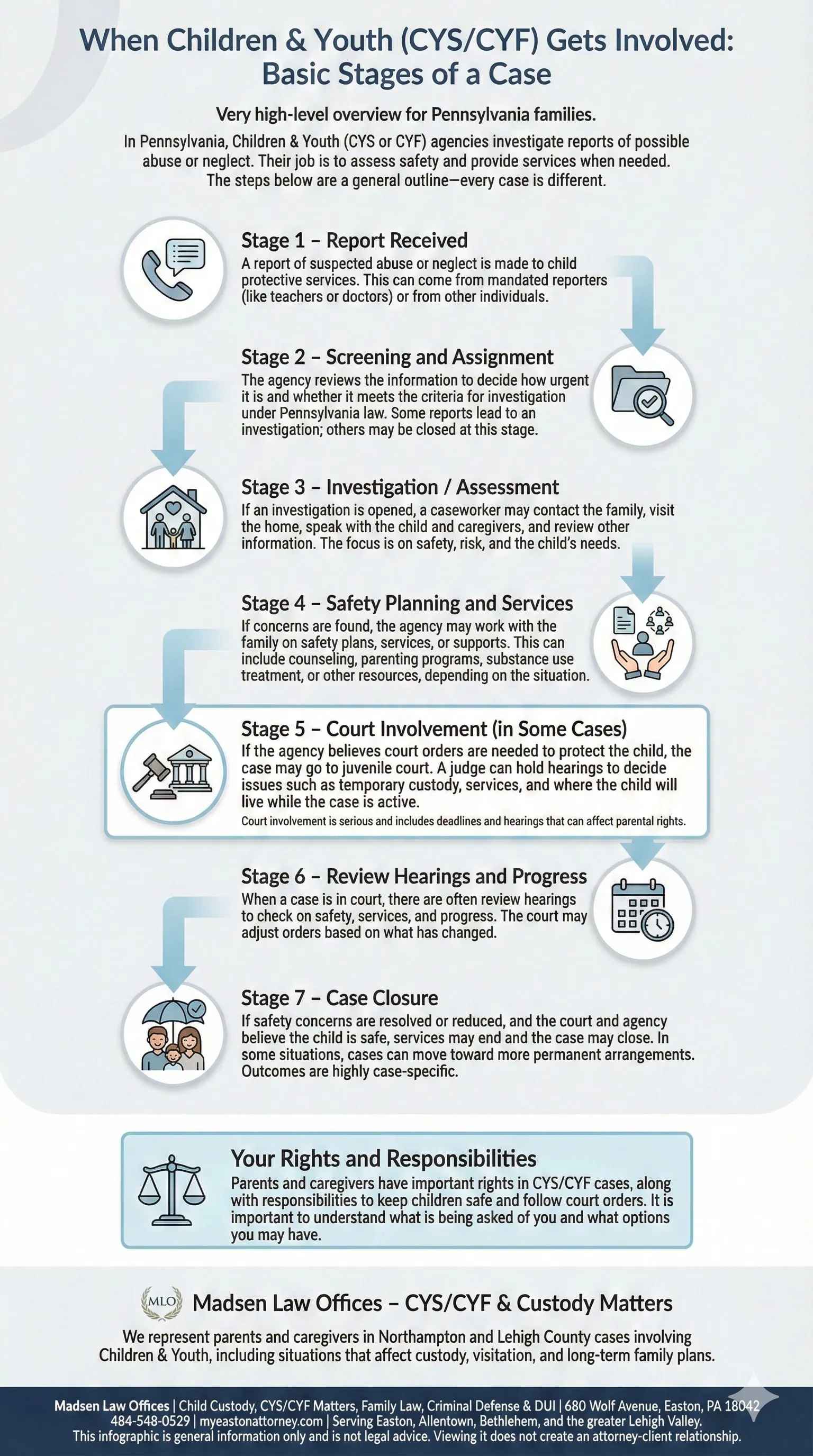
Our Approach to Juvenile Dependency, CYS, CYF, CPS and Child Abuse & Neglect Cases in the Lehigh Valley
Our Child Abuse Attorneys take a unique and nuanced approach to Juvenile Dependency case. Due to certain stages requiring very different levels of evidence, our tactics and strategies tend to vary between extremes. We aim to help our clients make a clear and accurate initial presentation during initial investigations in the hopes of avoiding court involvement. If there is court involvement we will usually take an aggressive posture in defending the case while at the same time advising our client to be cooperative as possible. As we believe the Dependency Adjudication Hearing to be the most important hearing, that is where we plan our battle. If we are involved in a case after the Adjudication Hearing has already happened, we will help our clients to comply with court recommendations and to assure that those recommendations are reasonable.
Frequently asked questions
What is the difference between an unfounded, indicated, and founded report?
Unfounded means the report is neither founded nor indicated; it does not necessarily mean the allegation was affirmatively proved false. Indicated means the agency determined that substantial evidence supports the report; it is not a judicial adjudication. Founded means the report rests on one of § 6303's qualifying outcomes, which can include guilty pleas or findings, dependency or delinquency adjudications, ARD dispositions, juvenile consent decrees, or final PFA orders meeting the statutory conditions. Indicated reports generally carry a 90-day appeal deadline. 23 Pa.C.S. §§ 6303, 6341.
How long do I have to challenge an indicated report?
Ninety days from notice of the report's status to request administrative review or a merits hearing. If administrative review is chosen, DHS must send its decision within 60 days; a denial starts a separate 90-day period to request a hearing. A later good-cause request may sometimes be available, but it is not a substitute for a timely appeal. Follow the notice's filing instructions exactly. 23 Pa.C.S. § 6341.
Do I have to sign a safety plan?
An agency-proposed safety plan is not itself a court order and ordinarily depends on caregiver agreement. Declining it may lead the agency to seek court-ordered restrictions or custody. If a plan is signed, the agency may later cite alleged noncompliance in court. Obtain advice before agreeing, refusing, or changing the arrangement, and obey every existing court order.
Can CYS take my child without a court order?
A county-agency worker may not take custody without judicial authorization. In a defined emergency, a police or juvenile-probation officer may take protective custody without a prior order; an application for a court order must follow within 24 hours, and the court must hold a shelter-care hearing within 72 hours. Limited medical protective custody also exists. At disposition, the court must make recorded findings before removing a dependent child. 23 Pa.C.S. § 6315; Pa.R.J.C.P. 1202, 1242; 42 Pa.C.S. § 6351(b).
What does the county agency have to prove for dependency?
The court may find a child dependent only on clear and convincing evidence. 42 Pa.C.S. § 6341(c). That is a higher burden than the preponderance standard used in ordinary civil cases.
Can a CYS matter affect my custody, PFA, or criminal case?
Yes. The proceedings remain separate, but statements, records, findings, and alleged plan violations may be sought or offered in another lane subject to the governing rules. Follow every order and deadline through one coordinated strategy. Read how PFA, custody, criminal, and firearms matters interact.