
Lehigh Valley Expungements & Pennsylvania Pardons
Expungement Lawyers in Easton, Bethlehem & Allentown.
Applying for Expungements & Pardons in the Lehigh Valley
Our Lehigh Valley Expungement Attorneys have obtained pardons, expungements and limited access orders for clients seeking to move forward without the stigma of a publicly accessible criminal record. Hopefully your criminal defense attorney discussed expungements with you at the time of your conviction. If not, our Easton Expungement Lawyers may still be able to help.
An expungement, or a pardon followed by expungement, can remove a conviction from your criminal record, though not every trace of it. Prosecutors and the State Police keep a nonpublic list of people whose records were expunged, along with their record information. That list may be used only to decide eligibility for diversion or probation programs, to identify people in criminal investigations and to grade a later offense. If you apply for a pardon, the Board of Pardons' records of its action on your case stay open to public inspection. Any conviction in a Pennsylvania state court can be considered for a pardon, though none is guaranteed. Without a pardon, far fewer convictions can be expunged, and eligibility depends on the offense, how long you have gone without a new arrest or prosecution and, in some cases, your age.
The Governor makes the final clemency decision, but under article IV, section 9 of the Pennsylvania Constitution, no pardon or commutation can be granted unless a majority of the Board of Pardons recommends it in writing. For a death or life sentence, the recommendation must be unanimous. The process begins with the constitutionally established Board of Pardons rather than the county courts.
On the other hand, Expungements are overseen by the Lehigh Valley court system and, in many cases, a petition may qualify for relief under 18 Pa.C.S. § 9122 or another applicable provision; notice, objections, and court procedure depend on the type of record and relief requested.
Outside of both pardons and traditional expungements are limited access orders. Limited access does not destroy criminal records; it keeps them from the general public, although police, courts and certain agencies and employers can still see them. Many non-violent misdemeanors may be eligible for limited access after a waiting period.

Pardon
Expungement
Limited Access Order
Benefits of Pardons & Expungements in The Lehigh Valley
How a pardon or expungement can help
1. Career Benefits
Lehigh Valley Employers look at criminal records. Our Expungement Attorneys in Easton can help.
Unfortunately criminal records can be detrimental to obtaining employment as well as advancing past a certain promotional level.
Many professional and occupational licensing agencies will not issue licenses to individuals convicted of certain crimes. Obtaining a Pardon or Expungement can open doors that would otherwise remain closed to an individual.
The practical value and legal effect of record relief depend on the person’s circumstances. Contact our expungement lawyers in Easton for help.
2. Firearm & Voting Rights
How different forms of relief may affect legal rights
Certain convictions prohibit individuals from buying, possessing or carrying firearms. Most Pennsylvanians with a criminal record can vote. The exceptions are people confined in a correctional facility for a felony conviction who will not be released by the next election, and people convicted of violating the Pennsylvania Election Code within the last four years. Other states may restrict voting based on a Pennsylvania conviction. A pardon or expungement may affect some legal disabilities, but the effect on firearm, licensing, immigration, or out-of-state rights depends on the exact record, the relief granted, and applicable Pennsylvania and federal law.
Related guide: How to Apply for Federal Firearm Rights Restoration (FFRR): A Pennsylvania Guide.
Should I Apply for a Pardon or Expungement?
What is the difference between a pardon and an expungement in Pennsylvania?
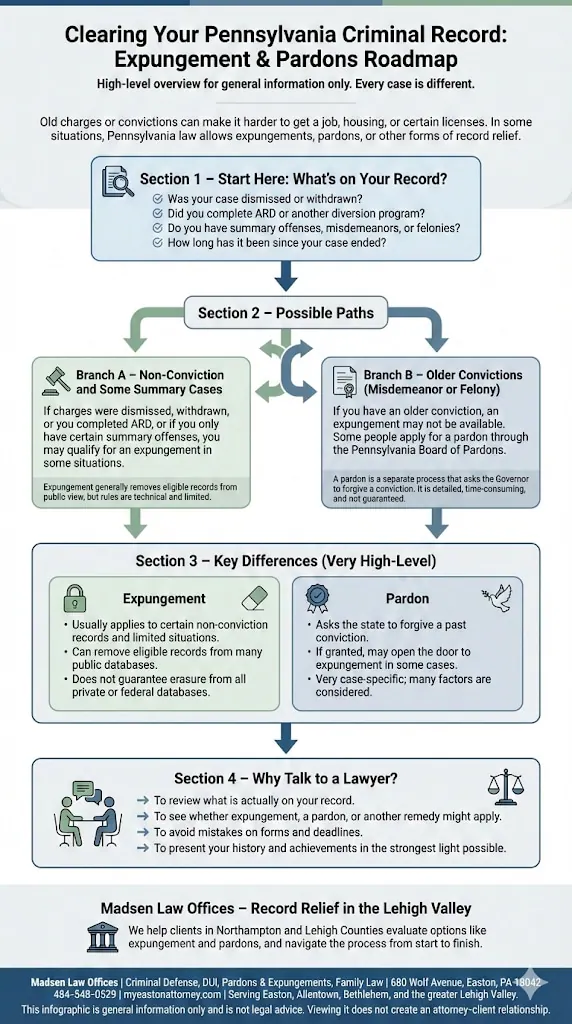
A pardon and an expungement have different functions. Current Board guidance advises that the ordinary clemency process may take a few years. Limited access, statutory expungement, and pardon relief each have different eligibility rules and effects, so the correct path depends on the exact record and the reason relief is needed.
The Pardon Process in Pennsylvania
What to Expect
The Pennsylvania Board of Pardons
The Board consists of the Lieutenant Governor, the Attorney General, and three Senate-confirmed gubernatorial appointees: a crime victim, a corrections expert, and a physician, psychiatrist, or psychologist.
The Pardon Process
After application processing and a Department of Corrections investigation, the Board conducts merit review and, if approved, a public hearing. A favorable recommendation is sent to the Governor, who makes the final decision. Current Board guidance advises that the process may take a few years.
Since June 11, 2024, convictions receiving an unconditional pardon are transmitted through the automatic expungement process under 18 Pa.C.S. § 9122(a.1). A pardoned applicant should verify that the process was completed accurately, but a separate expungement petition is not ordinarily required for a conviction covered by that provision.
Are you seeking a Pardon & Expungement in the Lehigh Valley?
We can review your record and explain which relief may be available.
Schedule a Consultation · (484) 548-0529
About This Information
This page addresses Pennsylvania law and common practice in Northampton and Lehigh Counties. Court procedures, deadlines, and available remedies can change and may depend on the facts, the assigned judge, and the governing order. The linked official sources should be checked for later amendments, and advice should be based on the specific matter.
Detailed Lehigh Valley Guidance
The overview above addresses immediate decisions. The sections below provide additional local and topic-specific detail.
Pardons, statutory expungement, and limited-access relief are different remedies with different eligibility rules and effects. The Board of Pardons publishes no categorical ordinary-clemency bar for Pennsylvania convictions, but filing an application does not guarantee a recommendation or a gubernatorial pardon. The effect of any relief depends on the jurisdiction, record, type of relief, and completion of any applicable expungement process under 18 Pa.C.S. § 9122.