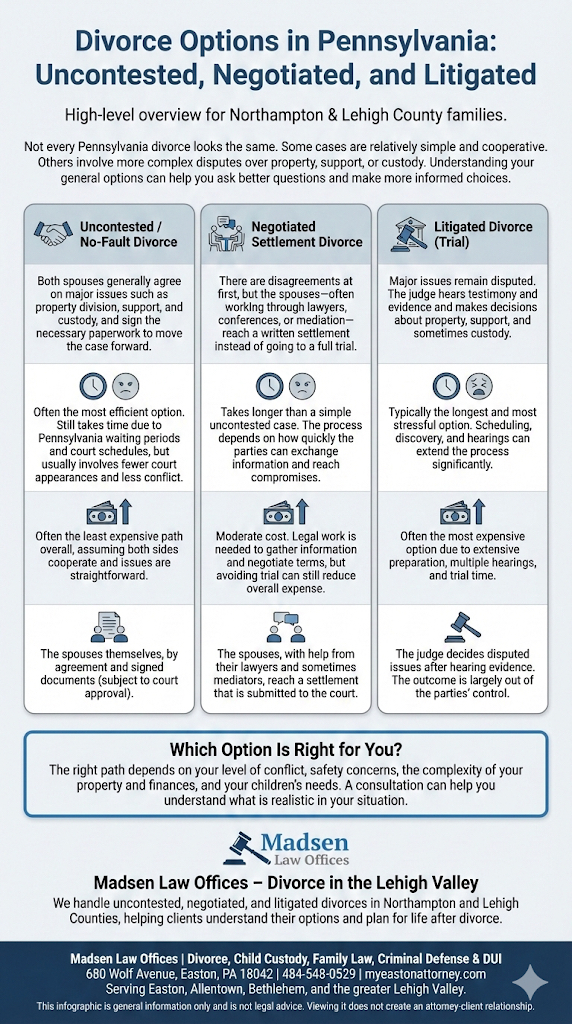
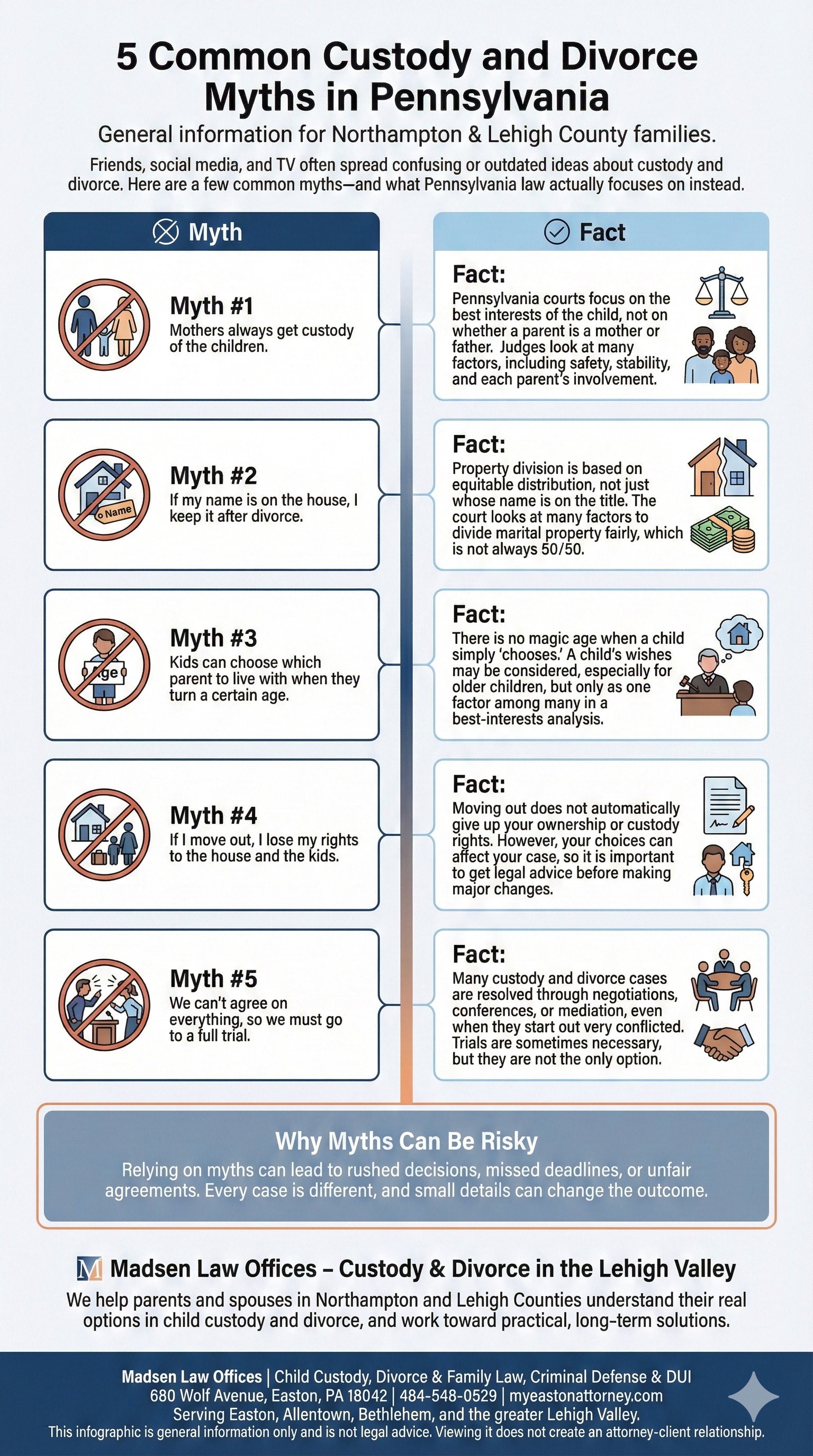
Divorce Attorneys located in Easton, Pennsylvania providing legal advice regarding Marriage & Divorce in Lehigh, Monroe & Northampton Counties.
At our Easton Family Law Office, our dedicated Divorce Attorneys have successfully guided numerous individuals through the complexities of divorce proceedings in Northampton County, Lehigh County, and across the Lehigh Valley. Whether you’re facing an uncontested divorce, navigating a high-asset separation, or dealing with a no-fault divorce, our skilled lawyers in Easton, Pennsylvania, are committed to providing the support and legal expertise you need.
Divorce is a multifaceted process that involves both emotional and financial separation. Our attorneys understand the challenges of disentangling your marital partnership from the legal bond and are here to assist you, regardless of your income level. We recognize that you’re embarking on a new chapter in your life, and our goal is to facilitate this transition with compassion and proficiency.
Each decision made during the divorce process carries significant consequences, both immediate and long-term. Our experienced Divorce Attorneys in Easton excel in safeguarding your interests, devising innovative solutions, and resolving your case swiftly and effectively. We strive to reduce conflict and costs, mitigate the impact on your children, and promote a constructive co-parenting relationship. Should negotiations stall, our assertive Lehigh Valley Divorce Attorneys are prepared to take decisive action to defend your rights.
Our Easton Divorce Lawyers will navigate you through every step of the divorce journey, helping you manage your emotions and make well-informed choices for your future. Serving clients from all walks of life, including professionals and business owners, our Northampton County Family Law Office represents both men and women in the Allentown, Bethlehem, and Easton regions, as well as throughout Northampton County and Lehigh County. We are your steadfast allies in family law, committed to achieving the best possible outcome for you and your family.
Top 10 Things to Know About Divorce in Pennsylvania

Understanding Legal Relief in Contested and Uncontested Divorces in Lehigh Valley: Whether you are navigating a contested or uncontested divorce in the Lehigh Valley, you or your spouse may be eligible for various forms of legal relief. This can encompass Equitable Distribution, which ensures a fair division of marital assets and debts, as well as Support Payments, which may take the form of Alimony or Spousal Support to maintain financial stability post-divorce. Child Custody Determinations are also a critical aspect, focusing on the well-being of children involved. It’s important to note that divorces can have broader implications, including potential tax and immigration consequences. Furthermore, the legal processes can vary between Lehigh County and Northampton County, each with its own set of procedures for handling divorce cases. Our firm is adept at guiding you through these nuances to achieve a resolution that aligns with your interests.
Equitable Distribution in Pennsylvania Divorce: Equitable distribution is a legal principle applied in Pennsylvania divorces to determine the fair division of marital property and debts. Unlike community property states where assets are split 50-50, equitable distribution aims to achieve a just allocation based on the unique circumstances of each case. In Pennsylvania, only marital property—assets and income acquired during the marriage—is subject to division. Non-marital property, such as assets owned prior to marriage, inheritances, and gifts (except those between spouses), typically remain with the original owner. However, any increase in value of separate property during the marriage may be considered marital and thus divisible. Additionally, debts incurred during the marriage are also subject to equitable distribution. Courts consider various factors, including the length of the marriage, each spouse’s financial situation, contributions to the marriage, and future earning potential, to decide on a fair division.
Alimony in Pennsylvania Divorce: Alimony, also known as spousal support, is a financial obligation one spouse may be required to provide to the other following the dissolution of marriage. In Pennsylvania, alimony is not automatic or guaranteed; it is awarded at the court’s discretion based on a set of 17 factors outlined in the Pennsylvania Divorce Code. These factors include the duration of the marriage, the age and health of both parties, earning capacities, and the standard of living established during the marriage. Alimony aims to help the receiving spouse maintain a similar standard of living to that enjoyed during the marriage and to support them as they transition to financial independence.
“Spousal Support and APL in Pennsylvania Divorce: Spousal support, also known as alimony pendente lite (APL), is a form of financial assistance provided to a lower-earning spouse during the divorce process. In Pennsylvania, spousal support is typically awarded after separation but before a divorce complaint is filed, while APL is granted after the divorce proceedings have begun but before the final decree is issued. Both are calculated based on the parties’ respective incomes and aim to ensure the dependent spouse can cover living expenses and legal costs during the divorce. It’s important to note that spousal support may be contested if the paying spouse can prove fault-based grounds for divorce, whereas APL does not allow for such defenses.
During your first consultation at our Easton, Pennsylvania law office, our proficient divorce attorneys will engage in a comprehensive discussion with you to cover various pivotal aspects of your divorce. Our conversation will encompass the grounds for divorce, a thorough evaluation of marital assets to ascertain which properties are jointly owned and which are individually owned, and an analysis of both you and your partner’s financial standing, including income, savings, and retirement accounts. Additionally, our divorce lawyers will address any child custody matters, ensuring that every facet of your divorce is meticulously considered to safeguard your interests and prepare for the next steps in the legal process. This tailored approach ensures that we provide personalized and strategic guidance tailored to your unique situation.
Initial Consultation and Financial Considerations: At the outset of your divorce journey, our experienced divorce attorneys will sit down with you to meticulously evaluate the financial responsibilities that may arise between you and your spouse. This crucial step ensures that you are fully informed about the potential financial implications of your separation.
Child Custody Preview: Understanding the complexities of child custody is paramount. Our divorce lawyers will provide you with a preliminary assessment of any child custody considerations, offering clarity and guidance on this sensitive issue.
Filing for Divorce: Determining the most appropriate type of divorce filing is essential. Our legal team will help you understand whether a no-fault or uncontested divorce aligns with your circumstances, ensuring the process aligns with your best interests.
Choosing the Right Venue: The location of your divorce filing can significantly impact the proceedings. We will discuss the advantages of filing in Lehigh County, Northampton County, or another jurisdiction, tailoring our advice to your unique situation.
Navigating Discovery and Court Hearings: Our dedicated divorce attorneys are here to ascertain if discovery and court hearings are necessary for your case. Whether in Lehigh County or Northampton County, we are committed to providing the support and representation you need throughout your divorce process.
Affordable Divorce Solutions in Lehigh Valley: Navigating a divorce can be financially straining, with costs varying widely based on the complexity of the case. In Lehigh Valley, expenses can range from as low as $1,000 for an uncontested divorce to upwards of $20,000 for more involved proceedings. At our Easton-based law firm, we prioritize your financial well-being. Unlike other firms in Allentown, Bethlehem, and Easton that may extend billable hours, our dedicated divorce attorneys focus on efficiency and cost-effectiveness. We understand that extensive discovery processes, including interrogatories and document requests, can inflate expenses. However, we believe that most divorce cases can be resolved without such costly measures. Our commitment is to deliver the best possible outcomes for our clients while keeping expenses to a minimum, ensuring a smoother transition into the next chapter of your life.
Total Attorney Fees in our Lehigh Valley Divorce Cases:
By following these steps, you’ll be better prepared to navigate the divorce process in Pennsylvania. Remember, every divorce is unique, so tailor these recommendations to your specific situation and consult with a professional for personalized advice.
You may get divorced without an attorney but it is not smart. You will be held to the same standard as the best divorce attorneys in the Lehigh Valley and will face a serious disadvantage, especially if the other party has a top divorce attorney knowledgeable in Pennsylvania divorce law.
Contact our Lehigh Valley Divorce Lawyers to learn more if you are considering a divorce in Northampton County or Lehigh County.
You should contact our Divorce Attorneys in Easton, Pennsylvania right away. If you do not respond to a Pennsylvania divorce complaint, a divorce decree may be entered even without your consent and your legal rights including the right to support or division of marital assets and debts may be waived. You should contact a Lehigh Valley Divorce Attorney to best handle your Northampton County or Lehigh County divorce.
If the spouse requesting the divorce fulfills all of the legal requirements the contesting party cannot prevent a divorce but they may be able to make it more difficult by requesting marriage counseling and delaying the finalization of the divorce for two years.
Call our Family Lawyers in Easton, Pennsylvania to learn more about divorce in either Lehigh County or Northampton County.
Yes, the court can require marraige counseling but rarely does so unless requested by one of the spouses. Ask the Lehigh County and Northampton County divorce lawyers in our Easton, Pennsylvania Family Law Office more about this.
Virtually all Pennsylvania divorces filed in Northampton County and Lehigh County are no-fault divorces. Yet this does not mean it is a simple process to file for a no-fault divorce. Strict rules regarding timelines to file certain documents and the contents of those documents present many pitfalls to even the most amicable divorce. While most divorces are no fault, adultery other issues are still defenses to support and equitable distribution.
Ask our family lawyers for more information at a free consultation in our Easton law office.
Yes, but this rarely happens under Pennsylvania divorce law, it is much more common under the PFA and Domestic Violence laws. However, in many cases, asking to have a spouse removed from the home may be more damaging to your case than it is useful.
Contact our Northampton County Divorce Lawyers to learn more.
Marital Property is property acquired by the parties during marriage. It is defined by 23 Pa. C.S. § 3501(a)1-8.
The Pennsylvania Divorce Code establishes a presumption that all property acquired from the date of marriage to the date of final separation is marital property except that which is defined as non-marital property as defined in Title 23 Pa. C.S. § 3501(a)1-8
1. Property acquired prior to marriage or property acquired in exchange for property acquired prior to the marriage.
2. Property excluded by valid agreement of the parties entered into before, during or after the marriage.
3. Property acquired by gift, except between spouses, bequest, devise or descent or property acquired in exchange for marital assets.
4. Property acquired after final separation until the date of divorce, except for property acquired in exchange for marital assets.
5. Property which a party has sold, granted, conveyed or otherwise disposed of in good faith and for value prior to the date of final separation.
6. Veterans’ benefits exempt from attachment, levy or seizure pursuant to the act of September 2, 1958 (Public Law 85-857, 72 Stat. 1229), as amended, except for those benefits received by a veteran where the veteran has waived a portion of his military retirement pay in order to receive veterans’ compensation.
7. Property to the extent to which the property has been mortgaged or otherwise encumbered in good faith for value prior to the date of final separation.
8. Any payment received as a result of an award or settlement for any cause of action or claim which accrued prior to the marriage or after the date of final separation regardless of when the payment was received.
Equitable Distribution is the division of the marital property of the divorcing couple by the court. These assets can include:
Annuities
Art Objects
Automobiles
Bank Accounts
Businesses
Certificates of deposit
Contents of safe deposit boxes
Furniture
Homes
Jewelry
Legal claims and awards
Life Insurance
Money and debts owed by others
Mortgages
Partnerships
Pension plans
Personal Property
Real Estate
Retirement benefits
Severance pay
Stocks, bonds, securities and option
Trusts
The division of marital property in Pennsylvania is defined in section 3502(a) of the Pennsylvania Divorce Code. There are 11 factors set forth to determine the equitable division of martial property.
1. The length of the marriage;
2. Any prior marriage of either party;
3. The age, health, station, amount and sources of income, vocational skills, employability, estate, liabilities and needs of each of the parties;
4. The contribution by one party to the education, training or increased earning power of the other party;
5. The opportunity of each party for future acquisitions of capital assets and income;
6. The sources of income of both parties, including, but not limited to, medical, retirement, insurance or benefits;
7. The contribution or dissipation of each party in the acquisition, preservation, depreciation or appreciation of the marital property, including the contribution of a party as homemaker;
8. The value of the property set apart to each party;
9. The standard of living of the parties established during the marriage;
10. The economic circumstances of each party, including Federal, State and local tax ramifications, at the time the division of property is to become effective;
11. Whether the party will be serving as the custodian of any dependent minor children
Pennsylvania is not a community property state where division of marital property is on a 50/50 basis; rather, in Pennsylvania a court is authorized by statute to equitably divide, distribute, or assign, marital property between the parties without regard to marital misconduct in such percentages as the court deems just after considering the above referenced relevant factors.
If you need any legal assistance in the Lehigh Valley, please feel free to contact us. Our Easton Law Office will get back to you within one business day. Or, just call us now.
Call :(484)548-0529
Mon – Fri 09:00-17:00